CodeRabbit Alternatives: Revix vs CodeRabbit
Revix derives review rules from your repository and updates them on every merge. CodeRabbit runs on a config file your team maintains. Where each one wins, and what they cost.

Teams who go looking for a CodeRabbit alternative give the same two reasons: comment volume that stops getting read, and misses on the problems that live outside the diff.
Both come from one cause. A reviewer that only sees the changed lines has to guess what your repository already decided, and guessing produces volume.
CodeRabbit is the most widely installed AI reviewer on GitHub, over two million repositories. If a proven install base is your first criterion, that is a real argument and this page will not try to talk you out of it.
| Revix | CodeRabbit | |
|---|---|---|
| GitHub | Yes | Yes |
| Bitbucket | Yes, native | Yes |
| GitLab | In progress | Yes |
| Azure DevOps | No | Yes |
| Setup | One click, automatic | Manual setup for rules |
| Rules from your codebase | Yes, derived automatically | No, you write them |
| Rules improved on every merge | Yes | No |
| Conventional commit checks | Yes, learned from your history | Manual config |
| Repo-wide context | Yes, every plan | Capped: 1 repo Pro, 10 Pro Plus |
| IDE and CLI review | No | Yes |
| Free for public repos | Yes | Yes |
| Price per seat / month | €20 Starter, €40 Pro, billed annually | $24 Pro, $48 Pro Plus, billed annually |
Full Revix plans, including the monthly rate and the free tier for public repositories, are on the pricing page.
The same finding, reviewed twice
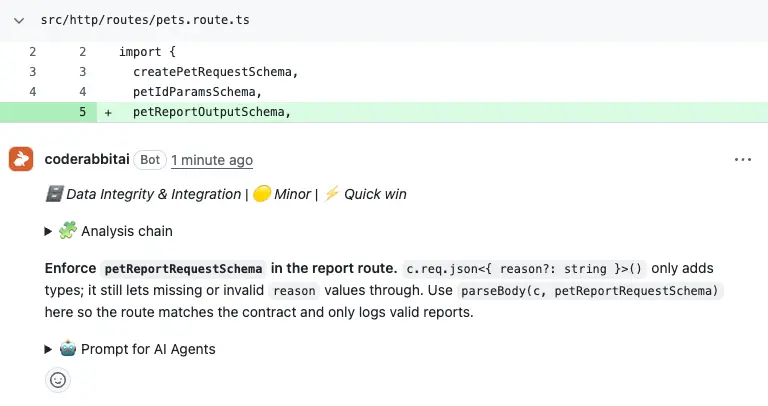
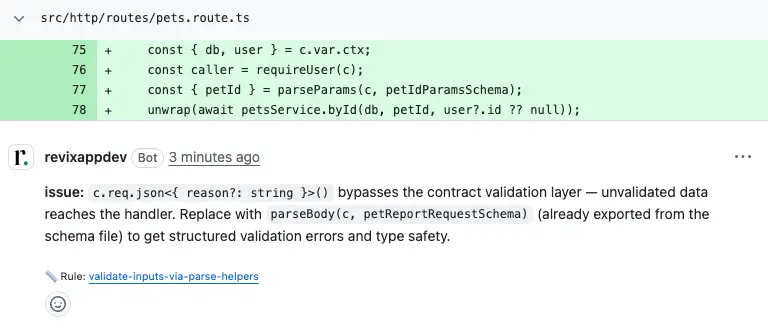
Both tools flagged the same thing on this pull request: a handler typing its request body with c.req.json<{ reason?: string }>() instead of validating it. Same bug, same suggested fix, two different reviews.
Three differences.
The tag. Revix opens with issue:, the Conventional Comments standard, so intent is one word and anything that parses the format can read it. CodeRabbit uses its own line: category, severity, effort. That carries more information, and an effort estimate is genuinely useful. It is also a vocabulary your team has to learn.
What it knows about the repo. Revix notes that parseBody is already exported from the schema file. It is not proposing a helper, it is pointing at one the codebase already has.
The rule. Revix links validate-inputs-via-parse-helpers, a rule derived from this codebase. The author is not being told what a reviewer prefers on this line. They are being shown the standard the repo already holds, with everywhere else that follows it one click away.
That third one is the difference we care about. Both comments get the line fixed. Only one of them means the next handler is written correctly the first time, by a developer who now knows the convention. This is the repo-aware side of the split, applied to a single comment.
Where Revix is better
Nothing to configure. Connect the repository and the first review runs. Revix reads the codebase and derives the rules itself. With CodeRabbit, the rules that make reviews match your team are a config file someone has to write, and keep writing.
Context is not a plan tier. CodeRabbit's cross-repository understanding comes through linked repository analysis, capped at one repo on Pro and ten on Pro Plus. Revix reads the full repository on every plan, including the cheapest one.
The rules also keep moving. After a pull request merges, Revix reads it again and asks whether the definition of correct just changed. Across 129 merge analyses that loop created 87 rules, refined 47, and retired 3. The retirements matter as much as the additions. Numbers are in What 200 Pull Requests Taught Us.
Your commit conventions, not a template. Revix reads your merged history and checks new commits and pull request titles against the format your team actually uses. No convention file to maintain.
Bitbucket was a primary target, not the fourth integration to get support. Both products work with it. On Revix the Jira link and branch-key resolution behave the same there as on GitHub.
On comment volume
The complaint that sends people looking is noise, and it is not a CodeRabbit-specific flaw. A reviewer with narrow context has to guess at relevance, and guessing produces volume. One that knows the repository can stay quiet, because it can tell a deliberate exception from a mistake.
We measure that as signal rate: 70% across 216 comments. Ask any tool you evaluate for the same number. If you have not compared the two review models before, what AI code review actually catches covers the mechanics.
Where CodeRabbit is better
Platform coverage. GitHub, GitLab, Azure DevOps, Bitbucket. Revix covers GitHub and Bitbucket, with GitLab in progress. If you are on Azure DevOps today, stop here and pick CodeRabbit.
It reviews before you push. IDE and CLI review, so feedback arrives before the pull request exists. Revix reviews pull requests only.
More in the box. Linters and SAST, docstring generation, an issue planner. One vendor instead of two.
Track record. Two million repositories is a lot of production exposure. We are much younger and we are not going to pretend otherwise.
Those are real advantages and worth weighing. Most of them are about coverage and surface area rather than what the reviewer knows about your repository on day one.
Which to pick
Pick Revix if your reviews keep missing what lives outside the diff, you would rather not maintain a rules file, you are an Atlassian shop, or you want a standard that tracks your codebase instead of freezing at onboarding.
Pick CodeRabbit if you are on Azure DevOps, want IDE and CLI review, or want static analysis from the same vendor.
Run both for two weeks on the same repository and count the comments each one posted that someone acted on.
Try it against your own repo: userevix.com. Every team starts with a 14 day free trial, no card required.
Pricing on both sides verified 30 July 2026, CodeRabbit against coderabbit.ai/pricing. Products change. If something here is out of date, tell us and we will fix it.
Frequently asked questions
Keep reading
- Repo-Aware AI Code Review vs. Diff-Based ReviewMost AI code reviewers only read the pull request. The ones that read the whole repo catch what a diff alone can't, like broken conventions, duplicate abstractions, and architectural drift.
- What Is AI Code Review and How Does It Work?How AI code review works stage by stage, what it reliably catches, where it fails, and the one difference between tools that decides what yours can find.